
Howard Miller Mantel Clock Instructions: A Comprehensive Guide
Howard Miller offers diverse instruction manuals and guides online, aiding owners in maintaining and repairing their treasured timepieces, from antique to modern models.
Understanding Your Howard Miller Mantel Clock
Howard Miller mantel clocks represent a legacy of quality craftsmanship and timeless design. Before delving into specific instructions, appreciating your clock’s intricacies is crucial. These clocks often feature intricate movements – weight-driven, quartz, or cable-driven – each requiring unique care.
Understanding the type of movement dictates winding procedures, battery needs, and potential troubleshooting steps. Many resources, including downloadable PDF manuals, are available online to assist owners. Familiarizing yourself with the clock’s components, like the pendulum, weights (if applicable), and chime mechanisms, will enhance your ability to maintain its accuracy and longevity. Proper care ensures your Howard Miller clock remains a cherished heirloom for generations.
Identifying Your Clock Model
Accurately identifying your Howard Miller mantel clock model is the first step towards accessing the correct instructions and support. The model number is typically located on a sticker affixed to the clock’s movement, inside the case, or on the back panel.
This number is essential when searching for specific manuals on the Howard Miller website or third-party archive sites. Without the correct model number, finding tailored guidance for your clock’s features and maintenance can be challenging. Detailed product manuals and instructions are readily available online, ensuring you have the resources needed for proper care and operation of your timepiece.
Locating the Instruction Manual
Finding the correct instruction manual for your Howard Miller mantel clock is crucial for proper setup and maintenance. Begin by checking within the original packaging – many clocks include a printed manual. If the original isn’t available, numerous resources exist online.
Howard Miller’s official website is the primary source, offering a comprehensive library of downloadable PDFs. Additionally, various third-party archives specialize in antique clock repair and often host manuals for different brands, including Howard Miller. Knowing your clock’s model number, as previously discussed, will significantly streamline this search process.
Downloading Manuals from Howard Miller Website
The Howard Miller website (www.howardmiller.com) provides a dedicated section for product manuals and instructions. Navigate to their support or resources area, then search using your clock’s model number. Accurate model identification is key for a successful search.
Available manuals are typically in PDF format, allowing for easy download and viewing on various devices. These digital copies often contain detailed diagrams, setup guides, and troubleshooting tips. Howard Miller frequently updates its online archive, ensuring access to the latest information for both current and legacy clock models.
Accessing Third-Party Manual Archives
While Howard Miller’s official website is the primary source, several third-party websites archive clock manuals, including those for Howard Miller timepieces. These resources can be invaluable if you’re unable to locate your manual on the official site, or if you possess a very old model.
Websites specializing in antique clock repair often host downloadable PDFs. Be cautious when downloading from unofficial sources; verify the file’s safety with antivirus software. Resources like manualslib.com or similar platforms may contain user-uploaded manuals, offering a broader range of options for finding your specific clock’s instructions.

Setting Up Your Howard Miller Mantel Clock
Proper placement and leveling are crucial for accurate timekeeping; ensure a stable, flat surface before installing batteries or winding mechanical movements.
Initial Clock Placement
Careful clock placement is paramount for optimal performance and longevity. Select a location away from direct sunlight, extreme temperatures, and humidity fluctuations, as these can negatively impact the clock’s delicate mechanisms. Ensure the surface is perfectly level and stable – even a slight incline can affect accuracy, particularly in mechanical movements.
Avoid areas prone to vibrations, such as near speakers or heavy foot traffic. Consider the surrounding décor; a mantel clock should complement its environment without being overshadowed. Prioritize a spot where the chime will be clearly audible, yet not disruptive. Remember to allow sufficient space around the clock for easy access during winding or battery changes, if applicable. A well-chosen location safeguards your Howard Miller clock for years to come.
Leveling the Clock
Precise leveling is crucial for accurate timekeeping, especially with mechanical Howard Miller mantel clocks. Use a small bubble level placed on top of the clock case to check for evenness. If the bubble isn’t centered, adjust the clock’s feet – many models feature adjustable levelers underneath.
Turn the feet clockwise or counterclockwise until the bubble is perfectly centered, indicating a level surface. Re-check the leveling from multiple angles to ensure accuracy. An unlevel clock can cause the pendulum to swing unevenly, leading to timekeeping errors or even stopping. Consistent leveling guarantees optimal performance and preserves the clock’s intricate mechanism, ensuring reliable operation for years.
Installing Batteries (If Applicable)
For quartz Howard Miller mantel clocks, battery installation is straightforward. Locate the battery compartment, typically on the clock’s underside or back. Refer to your specific model’s manual for the correct battery type – often C or D cells.

Insert the batteries, observing the correct polarity (+ and -) as indicated within the compartment. Ensure a snug fit for a secure connection. Avoid mixing old and new batteries, or different battery types. After installation, the clock should begin functioning immediately. If not, double-check the battery polarity and compartment contacts for corrosion; Proper battery installation ensures reliable timekeeping.
Winding the Clock (Mechanical Movements)
Howard Miller mechanical mantel clocks require regular winding to maintain operation. Locate the winding key, often stored within the clock or provided separately. Gently insert the key into the winding arbors – typically three holes – one for time, one for chime, and one for strike.
Wind each arbor slowly and steadily clockwise until you feel resistance; avoid over-winding, which can damage the movement. The frequency of winding depends on the clock’s design, but generally, weekly winding is sufficient. Consistent winding ensures accurate timekeeping and the beautiful chime and strike functions characteristic of Howard Miller clocks.

Time Setting Procedures
Howard Miller clocks offer standard time-setting methods; carefully adjust hands while preventing damage, and synchronize with a reliable time source for precision.
Setting the Time – Standard Methods
Generally, Howard Miller mantel clocks utilize a traditional method for time setting. Locate the time adjustment knob, typically found on the clock’s movement face. Gently pull the knob outward to disengage the time-setting mechanism; avoid excessive force. Rotate the knob clockwise or counterclockwise to move the hands to the correct time.
Ensure the date is also correctly set if your clock features a date display. Once the desired time is achieved, carefully push the knob back in to re-engage the timekeeping function. Always observe the hands’ movement to confirm proper engagement. Some models may have a separate night/day selector; adjust accordingly. Refer to your specific model’s manual for detailed instructions, as variations exist.
Synchronizing with a Time Source
For precise timekeeping, synchronizing your Howard Miller mantel clock with a reliable time source is crucial, especially for clocks without automatic time synchronization. Utilize a trusted online time server (like time.gov) or a radio-controlled time signal. After setting the initial time using standard methods, monitor the clock’s accuracy over several days.
If discrepancies arise, gently adjust the time again, striving for minimal deviation. Some newer models may offer synchronization features; consult your manual. Regularly checking and adjusting ensures consistent accuracy. Remember, environmental factors can influence timekeeping, so periodic adjustments are normal. Accurate synchronization enhances the longevity and reliability of your clock;
Day and Date Adjustment
Many Howard Miller mantel clocks feature day and date displays, requiring separate adjustment procedures. Typically, a small recessed button or a crown allows for setting the day of the week. Rotate it carefully until the correct day appears. Date adjustment often involves pulling out the crown to a different position, then rotating it to set the desired date.
Consult your specific model’s instruction manual for precise instructions, as procedures vary. Avoid forcing any controls. Be mindful of AM/PM settings when adjusting the time, as this impacts date accuracy. Regularly check the day and date to ensure correct display, especially after power outages or battery changes.

Maintaining Your Clock
Howard Miller clocks benefit from regular cleaning, proper lubrication, and pendulum adjustments to ensure accuracy and longevity of these beautiful timekeeping instruments.
Regular Cleaning Practices
To preserve the beauty and functionality of your Howard Miller mantel clock, consistent cleaning is essential. Use a soft, dry cloth to gently dust the clock case regularly, avoiding abrasive cleaners or polishes that could damage the finish. For intricate carvings or detailed surfaces, a soft brush can effectively remove dust buildup.
Periodically, a slightly dampened cloth (with water only) can be used to wipe down the case, ensuring it’s immediately dried afterward. Avoid getting moisture near the movement. The glass covering the clock face should be cleaned with a glass cleaner, applied to the cloth, not directly onto the glass.
Remember to disconnect power sources (batteries or unplug the clock) before cleaning. Consistent, gentle cleaning will maintain the clock’s appearance and prevent the accumulation of dust that can affect its delicate mechanisms.
Lubrication Guidelines
Howard Miller clocks, particularly mechanical movements, require periodic lubrication to ensure smooth operation. However, attempting to lubricate the movement yourself is generally discouraged unless you possess specialized knowledge and tools. Improper lubrication can cause more harm than good, leading to increased friction and potential damage.
If you are comfortable, use only high-quality clock oil specifically designed for clock movements. Apply sparingly to pivot points and gears, avoiding over-lubrication. Quartz movements typically do not require manual lubrication.
It’s highly recommended to entrust lubrication to a qualified clock repair technician during a professional servicing. They have the expertise to properly disassemble, clean, lubricate, and reassemble the movement, guaranteeing optimal performance and longevity for your cherished Howard Miller clock.
Pendulum Adjustment for Accuracy
Achieving accurate timekeeping with a Howard Miller mantel clock featuring a pendulum often requires minor adjustments. Observe the clock’s performance over several days to determine if it’s running fast or slow. If fast, slightly lengthen the pendulum rod by turning the rating nut (usually located at the bottom of the pendulum).
Conversely, if the clock is running slow, shorten the pendulum rod by turning the rating nut in the opposite direction. Make small adjustments – a quarter turn at a time – and allow the clock to settle before making further changes.
Ensure the clock is level, as an uneven surface can affect pendulum swing and accuracy. Patience and careful observation are key to fine-tuning your clock’s timekeeping.

Troubleshooting Common Issues
Howard Miller clock problems include inaccurate time, chiming malfunctions, a stopped pendulum, or battery failures; solutions often involve adjustments or professional repair services.
Clock Not Keeping Accurate Time
If your Howard Miller mantel clock isn’t maintaining accurate time, several factors could be at play. First, ensure the clock is positioned on a perfectly level surface, as even a slight incline can affect the pendulum’s swing and, consequently, timekeeping.
For mechanical clocks, verify proper winding; insufficient winding leads to decreased power and inaccuracy. Pendulum adjustment is crucial – a longer pendulum slows the clock, while a shorter one speeds it up. Make small adjustments and observe the results over a 24-hour period.
Quartz clocks rely on batteries; a low battery is a common culprit. Replace the battery with a fresh one. If the issue persists, the movement itself might require professional attention from a qualified clock repair technician.
Chiming Malfunctions
Howard Miller clocks are renowned for their chimes, but occasional malfunctions can occur. If the chime is silent, first check the chime silence lever – it may be engaged. For mechanical clocks, ensure the chime train is properly wound, as chiming requires separate power.
Inspect the chime rods or tubes for any obstructions or damage. A gentle cleaning might resolve minor issues. If the chime sounds incorrect or incomplete, the chime sequence may need adjustment, best left to a professional.
Quartz clocks with electronic chimes may have settings controlling chime volume or frequency; consult your manual. Persistent chime problems often indicate a need for professional repair.
Pendulum Stopping
A frequently encountered issue with Howard Miller mantel clocks is a pendulum that stops swinging. This often stems from an uneven surface; ensure the clock is perfectly level using a level tool. Insufficient lubrication can also cause friction, halting the pendulum’s motion – consult maintenance guidelines for appropriate oils.
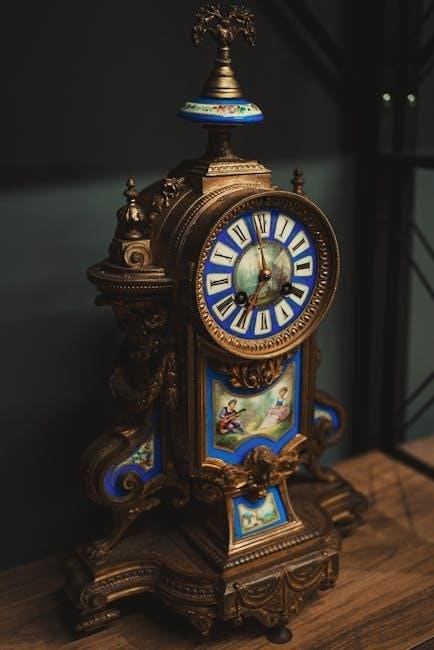
Check for obstructions hindering the pendulum’s swing, such as the clock case or internal components. A slightly bent pendulum rod can also cause issues; gentle straightening might help, but avoid forceful bending.
For mechanical clocks, a low wind can stop the pendulum; ensure adequate winding. If the problem persists, professional assessment is recommended.
Battery Issues (Quartz Clocks)
Howard Miller quartz mantel clocks rely on battery power; a common issue is a clock ceasing to function due to depleted batteries. Always use the correct battery type as specified in your clock’s manual – typically, these are alkaline batteries. Ensure correct polarity when installing new batteries (+/-).

Corroded battery terminals can prevent proper contact; clean them gently with a cotton swab dipped in rubbing alcohol. If a new battery doesn’t resolve the issue, check the battery compartment for any obstructions.
Occasionally, the quartz movement itself may be faulty, requiring professional repair or replacement.
Specific Movement Types & Instructions
Howard Miller clocks utilize weight-driven, quartz, and cable-driven movements; each requires unique handling for optimal performance and longevity, as detailed in manuals.
Weight-Driven Movement Instructions
Howard Miller weight-driven mantel clocks rely on the descent of weights to power the timekeeping mechanism. Carefully inspect the weights for damage before installation, ensuring they are securely attached to the cables or chains. Lower the weights slowly and deliberately, avoiding any sudden drops that could strain the movement.
Consistent winding is crucial; wind the clock fully each week, or as recommended in your specific model’s manual. Observe the winding arbors – they should turn smoothly without excessive resistance. Avoid over-winding, as this can damage the mainspring. Regularly check the cable or chain for wear and tear, and consult a professional for replacements. Proper weight adjustment and consistent winding are key to accurate timekeeping in these classic clocks.
Quartz Movement Instructions
Howard Miller quartz mantel clocks are powered by batteries, offering reliable and low-maintenance operation. When installing batteries, always use the correct type as specified in your clock’s manual – typically AA or C size. Ensure proper polarity (+/-) alignment. Avoid mixing old and new batteries.
If the clock stops or displays inaccurate time, begin by replacing the batteries. Some models feature a “sync” button to re-establish time synchronization. Avoid exposing the clock to extreme temperatures or humidity, as this can affect battery performance. Regularly check the battery compartment for corrosion and clean as needed. These movements generally require minimal maintenance beyond battery replacement.
Cable-Driven Movement Instructions
Howard Miller cable-driven mantel clocks utilize a unique system where weights descend along cables to power the timekeeping mechanism. Winding involves carefully raising the weights using the provided key until resistance is felt. Avoid over-winding, as this can damage the cables or movement.
Regularly inspect the cables for wear and tear; fraying or damage requires professional attention. Ensure the weights descend smoothly without obstruction. These clocks often feature automatic winding capabilities, but manual winding may be necessary periodically. Proper cable maintenance is crucial for accurate timekeeping and longevity. Consult your specific model’s manual for detailed winding instructions.

Advanced Maintenance & Repair
Howard Miller clock repair often necessitates professional expertise; qualified technicians can diagnose complex issues and restore intricate mechanisms to their original functionality.
When to Seek Professional Help
Determining when your Howard Miller mantel clock requires professional attention is crucial for preserving its longevity and accuracy. If you’ve attempted basic troubleshooting – such as battery replacement or gentle pendulum adjustments – without success, it’s time to consult an expert. Complex issues like damaged gears, malfunctioning movements (weight-driven, quartz, or cable-driven), or significant chiming discrepancies demand specialized knowledge and tools.
Avoid disassembling intricate components yourself, as this could lead to further damage and costly repairs. A qualified clock repair technician possesses the expertise to diagnose problems accurately, perform necessary repairs, and ensure your clock continues to function flawlessly for years to come. Prioritize professional assistance for optimal results and to safeguard your investment.
Finding Qualified Clock Repair Technicians
Locating a skilled technician for your Howard Miller mantel clock requires careful consideration. Begin by seeking recommendations from local antique shops, clock collectors, or online forums dedicated to horology. The National Association of Watch and Clock Collectors (NAWCC) offers a directory of qualified members who provide repair services.
When contacting potential technicians, inquire about their experience specifically with Howard Miller clocks and the type of movement your clock utilizes. Request references and estimates before committing to any repairs. A reputable technician will be happy to provide detailed explanations of the necessary work and associated costs, ensuring transparency and your peace of mind.
Understanding Clock Repair Costs
Repair costs for your Howard Miller mantel clock can vary significantly based on the complexity of the issue and the technician’s rates. Simple repairs, like pendulum adjustment or minor cleaning, may range from $50 to $150. More extensive work, such as movement overhaul or chime repair, can cost between $200 and $600 or more.
Factors influencing the price include the clock’s age, movement type (quartz, mechanical, weight-driven), and the availability of replacement parts. Always obtain a written estimate detailing the scope of work and associated costs before authorizing any repairs. Be sure to inquire about potential additional charges for parts or unforeseen complications.